We Were Here Tomorrow co op: Setup, Tips & Gameplay
Explore We Were Here Tomorrow co op requirements, puzzle mechanics, beginner tips, PC specs, and what to know before playing with a partner.
We Were Here Tomorrow co op: What to Know First
Your partner might have the answer to your puzzle—and no idea how to describe it. We Were Here Tomorrow co op turns that communication gap into a two-player adventure, making your choice of teammate just as important as your puzzle-solving skills. Before you commit to We Were Here Tomorrow co op, it helps to understand its online requirements, asymmetrical roles, and potentially disorienting gravity mechanics.
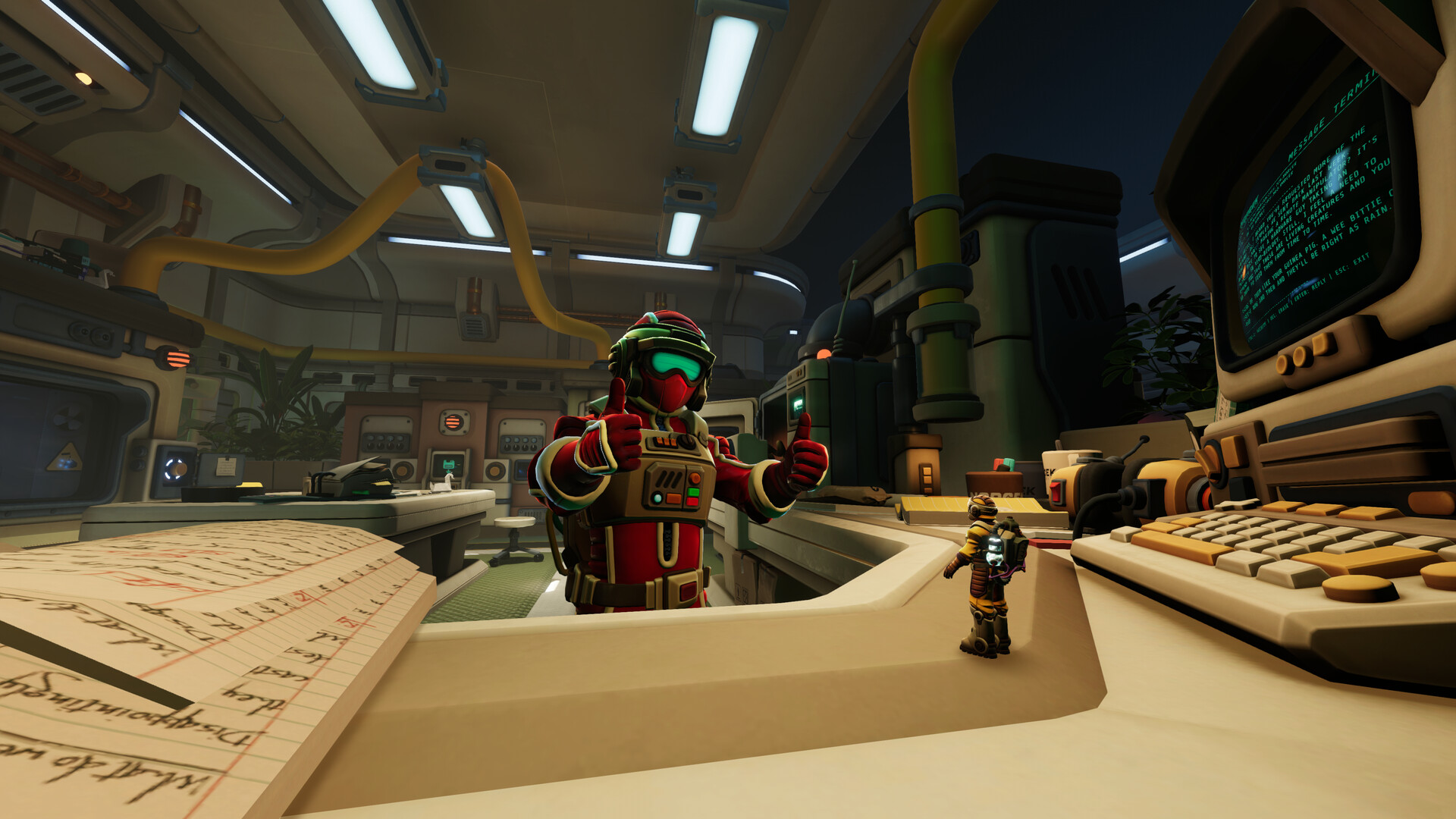
Official screenshot · Source: Steam store
Released on October 20, 2026, Total Mayhem Games’ latest adventure trades much of the series’ medieval atmosphere for a retro-futuristic research facility. The central challenge remains familiar: observe your surroundings, explain what your partner cannot see, and connect two incomplete perspectives.
This is a spoiler-light guide based on the official store information and a published reviewer’s player experience, rather than a firsthand playthrough.
Essential co-op details
| Question | What to know |
|---|---|
| How many players? | Two players, each with a distinct role |
| Can you play alone? | No; the official listing identifies the game as co-op only |
| What connection is required? | An internet connection |
| Do you need microphones? | The PC listing requires a working PC-compatible microphone for both players |
| Is online co-op supported? | Yes |
| Is cross-platform multiplayer listed? | Yes, although the supplied listing does not explain every supported platform pairing |
| Do you need the earlier games? | No; the developer describes each entry as a standalone adventure |
| When did it release on Steam? | October 20, 2026 |
The official We Were Here Tomorrow Steam listing is the primary source for requirements, current pricing, and multiplayer features.
One important distinction: two characters occupying the same room inside the game does not mean local split-screen support. The supplied Steam listing advertises online co-op, not a shared-screen mode. Plan around online play, and verify your intended platform combination before purchasing.
How the Asymmetrical Co-op Puzzles Work
The defining feature of We Were Here Tomorrow co op is unequal information. You and your partner do not simply solve identical puzzles side by side. Each player has a different role and high-tech equipment, so progress depends on combining observations and actions.
You may understand what needs to happen without having the tool to do it. Your partner may control the relevant machinery without being able to see the result. That separation makes conversation part of the puzzle itself.
A new setting with familiar teamwork
The adventure begins with two explorers trapped beneath Antarctic ice. They awaken inside a Norček Industries facility, where Director Kathleen Bowe asks them to continue the work of a missing research team.
Instead of relying primarily on castle corridors and ancient mechanisms, the game builds puzzles around scientific experiments. The official description highlights challenges involving time, gravity, and space, presented through an imagined 1980s vision of the future.
The available review describes both separated puzzle sections and stretches where partners share a space. That creates opportunities to explore together without abandoning the need for complementary roles.
| Puzzle element | How it affects teamwork | Useful habit |
|---|---|---|
| Different perspectives | Each player sees only part of the problem | Describe your surroundings before proposing a solution |
| Role-specific equipment | One player cannot perform every required action | Explain what your tool does and what it affects |
| Gravity manipulation | Players may navigate differently oriented surfaces | Agree on reference points instead of relying on “up” |
| Scale changes | One player can experience the environment at a different size | Describe landmarks relative to your current viewpoint |
| Electrical and laser mechanisms | Actions may affect something outside your view | Announce changes and wait for confirmation |
What the reported player experience suggests
In the published review, I Dream of Indie Games describes puzzles involving electrical connections, lasers, and technology associated with different times. One early sequence shrinks a player, changing both their environmental perspective and the pitch of their in-game voice.
That is a useful example of the game’s approach: the science-fiction premise affects how you cooperate, rather than serving only as decoration.
However, this player experience also identifies occasional subtle clues and unclear visual signals. Expect some sticking points to require another careful look around the room—not necessarily a more elaborate theory.
Beginner Tips for We Were Here Tomorrow co op
A strong We Were Here Tomorrow co op partnership does not require both players to think alike. It requires a reliable way to compare what each person knows.
The following habits are practical recommendations based on the game’s communication-focused design. They are not mandatory solutions or claims about hidden mechanics.
1. Test voice communication before settling in
Both players should check that their microphones work and speech is understandable. A puzzle built around verbal descriptions becomes much harder when a quiet voice, background noise, or microphone problem obscures a crucial detail.
The reviewer’s player experience notes that story dialogue can temporarily interrupt communication through the walkie-talkie. If that happens, wait until the dialogue finishes, then repeat the last important instruction.
2. Establish shared names and reference points
“The thing over there” is rarely helpful when your partner occupies another room.
Choose simple descriptions:
- “The console beside the entrance.”
- “The upper row, second position from the left.”
- “The symbol shaped like a fork.”
- “The surface with the red cable attached.”
These examples are communication templates, not descriptions of specific puzzle solutions. The goal is to create labels you can both reuse consistently.
Gravity sections make this especially important. Your “ceiling” may not be a useful reference for your partner. Name a fixed object or doorway instead.
3. Separate observation from interpretation
There is a difference between saying, “Three lights are flashing,” and saying, “I think you need to press three buttons.”
Start with the observation. Then explain your theory.
Otherwise, your partner may spend several minutes trying to follow an interpretation that was never supported by the actual clue. A short factual inventory gives both players room to reason.
4. Change one variable at a time
When you are stuck, rapid experimentation can make the puzzle harder to understand. If both players activate several controls simultaneously, neither knows which action produced the result.
| Step | Action | Why it helps |
|---|---|---|
| 1 | Describe the current state | Establishes a shared starting point |
| 2 | Propose one specific change | Keeps the test understandable |
| 3 | Have one player perform it | Avoids overlapping inputs |
| 4 | Ask the observer what changed | Connects the action to its effect |
| 5 | Keep or reverse the change | Builds a repeatable process |
This method is particularly useful when controls and their effects are separated between players.
5. Recheck the environment before seeking a walkthrough
The reviewer’s player experience specifically highlights computer screens, whiteboards, and posters as places where overlooked information can matter. Some screens reportedly contain background details, while others contribute to puzzle solving.
Before assuming you missed an obscure mechanic:
- Revisit screens that appear interactive.
- Read nearby written information.
- Look for details your partner has not heard about.
- Compare any patterns or terminology across both spaces.
- Summarize what you have already tested.
If frustration starts replacing useful discussion, take a break. Returning with a clearer head is often more productive than repeating the same unsuccessful sequence.
PC Requirements, Comfort, and Price
Before starting We Were Here Tomorrow co op, check both players’ hardware—not just the more powerful computer. Your shared session depends on both people being able to explore, communicate, and inspect clues comfortably.
Official PC specifications
| Component | Minimum | Recommended |
|---|---|---|
| Operating system | Windows 11, 64-bit | Windows 11, 64-bit |
| Processor | AMD Ryzen 5 3600 or equivalent | AMD Ryzen 5 5600X or equivalent |
| Memory | 8 GB RAM | 16 GB RAM |
| Graphics | Nvidia GTX 1660 Ti, 6 GB, or equivalent | Nvidia GeForce RTX 3060 or equivalent |
| DirectX | Version 12 | Version 12 |
| Storage | 25 GB available | 25 GB available |
| Connection and audio | Broadband internet and working PC-compatible microphone | Broadband internet and working PC-compatible microphone |
At the time of the supplied store capture, Steam Deck compatibility was Unknown. Do not treat controller support as confirmation of verified handheld compatibility.
Performance and motion-sickness considerations
The review’s player experience reports frame-rate drops in visually busy areas while using a high graphics preset. Because the review also discusses possible optimization before release, that observation should not be treated as a benchmark for the current launch build or every PC configuration.
If performance is inconsistent, try a lower graphics preset and compare the same scene before changing anything else.
Gravity manipulation deserves separate attention. The reviewer reports discomfort during sequences involving movement across walls and ceilings, even though they do not normally experience motion sickness.
If either partner is sensitive to perspective changes:
- Plan shorter sessions.
- Pause when discomfort begins.
- Avoid pushing through symptoms to finish a room.
- Consider comfort tolerance alongside puzzle difficulty when deciding whether to buy.
These are general precautions, not confirmed in-game accessibility options.
Launch pricing snapshot
The supplied Steam page lists a regular U.S. price of $19.99, with a 10% introductory discount to $17.99 ending November 3, 2026.
Prices can change and vary by region. The supplied sources do not establish a free friend-pass arrangement, so do not assume one purchase covers both players.
Is It a Good Fit for Your Co-op Partner?
The strongest reason to consider We Were Here Tomorrow co op is its commitment to interdependent problem solving. If your favorite cooperative moments involve explaining a strange diagram, testing a theory, and finally understanding your partner’s clue, its design is a promising match.
It may be less suitable if you want an effortless social game where conversation is optional.
| Your preference | Likely fit |
|---|---|
| Escape-room-style reasoning | Strong match with the core design |
| Distinct player roles and tools | Central to the experience |
| Colorful science-fiction environments | A major part of this entry’s identity |
| Minimal verbal communication | Poor match |
| Guaranteed short campaign | Completion time is not established by the supplied sources |
| Sensitivity to rotating viewpoints | Approach cautiously because of reported gravity-section discomfort |
The reviewer had played for eight hours without finishing. That supports planning for multiple sessions, but it does not establish an average completion time or prove the game is longer than every previous entry.
Early reception also calls for perspective. The October 21, 2026 Steam capture shows a Mixed rating, with 65% positive reviews among 182 Steam-purchaser reviews. That is an early snapshot, not a lasting consensus, and the supplied material does not establish why individual players voted negatively.
The practical takeaway: choose this for its communication puzzles and experimental setting, while weighing your tolerance for subtle clues, technical uncertainty, and gravity-driven perspective shifts.
FAQ
Can you play We Were Here Tomorrow co op solo?
No. The official Steam listing identifies it as co-op only. Its puzzles are built for two players with different roles, perspectives, and equipment.
Does it support local split-screen or crossplay?
The supplied Steam page lists online co-op and cross-platform multiplayer, but it does not list local split-screen. It also does not detail every supported cross-platform pairing. Check the relevant storefront information for both players’ systems before buying.
Do you need to play the previous We Were Here games?
No. The developer describes the series’ games as standalone online co-op adventures. Their stories connect, but playing them in release order is not required.
How long does the campaign take?
A reliable average is not established by the supplied sources. The published reviewer reports eight hours played with more remaining, so plan for multiple sessions rather than assuming you can finish in one evening.
Related Guides
We Were Here Tomorrow crossplay: Platform Guide
We Were Here Tomorrow crossplay supports PC, PS5, and Xbox Series X|S. See platform pairings, co-op requirements, and practical setup tips.
We Were Here Tomorrow friend pass: Co-op Access Explained
Is a We Were Here Tomorrow friend pass confirmed? Learn what the official announcement says about co-op access, crossplay, and playing with a friend.
We Were Here Tomorrow how many players: Co-op Guide
We Were Here Tomorrow requires exactly two players. Learn how online co-op works, what you need to play, and how to prepare with your partner.
We Were Here Tomorrow announcement: Release Details
Explore the We Were Here Tomorrow announcement, October 20 release, crossplay plans, co-op puzzles, Steam pricing, and PC requirements.
We Were Here Tomorrow demo walkthrough: Guide & Tips
Find the right We Were Here Tomorrow demo walkthrough, avoid wrong-game solutions, and use a practical checklist to work through co-op puzzles.